Why you should stop chanting cues at your dog November 2016
When you ask your dog to sit, do they do it immediately or do you have to repeat yourself a few times? Can you hear yourself saying “Sit, sit, sit, sit, sit…” or giving a hand signal over and over? If so I want to urge you to break the habit immediately and I will explain why.
“Cues” are stylized signals that we train dogs to tell them what behaviour to do when. Typically they are verbal and/or hand signals, however anything can be conditioned to be a cue for a behaviour such as “person approaching” being a cue to sit and the reward being the opportunity to greet the person.
“Cue chanting” is a common habit that most dog owners develop. When we cue our dog to do a behaviour and they they don't respond right away we have the urge to repeat ourselves. The problem is that this actually dilutes your cue and in the long run you will always be stuck repeating yourself. Wouldn't you rather your dogs learn to respond promptly first time you give the cue? The first step to achieving this goal is to STOP repeating it.
Instead say the cue ONCE and then ~just wait~ for the behaviour. Give the dog a chance to think about it. Most likely* the dog will eventually perform at which point you can reward them. The dog’s end goal is to get the reward and they want to figure out the fastest way to get it. With enough repetition the latency between the cue and the behaviour will disappear and you will have a dog who performs immediately on the first cue.
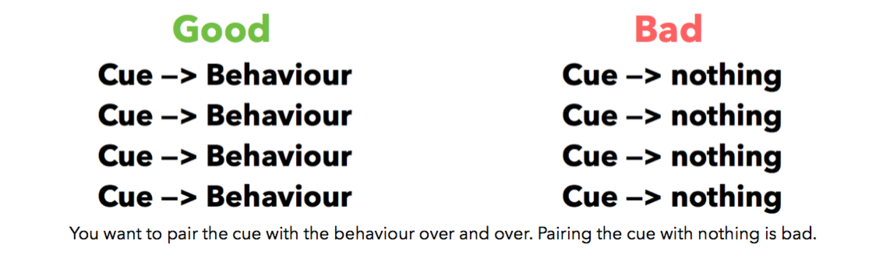
When you train this way you develop a strong connection between the cue being followed by the behaviour. You are pairing the two together over and over to develop the dog's habit of responding immediately. When you repeat the cue multiple times before getting the behaviour you create repetitions of the cue NOT being followed by the behaviour. This pairs the cue with nothing, weakening it's predictive value. It also teaches the dog that he can still be rewarded for responding the 5th, 6th, or 10th time you say it.
Cue chanting can be a hard habit to break. I once met a dog owner so entrenched in his chanting habit that when he asked my dog Shadow to sit, not only did he say the cue more then once, he continued to say “sit” several more times after Shadow had already sat! If you are currently a cue chanter, try to catch yourself in the act and make an effort to change your ways. It may take time but it will be worth the effort! Give your dog the chance to perform on the first cue!
VIDEO EXAMPLE: Below is a 45 second clip of "Just Waiting" from a training session teaching Scout the corgi the hand signal cue to lay down from sitting. We were working on fading the signal from a large one to a smaller one and this clip is mid way where I give the hand signal to my knee height. The point is to show that I give the cue ONCE and then wait for the response. I do not repeat the hand signal multiples times.
*This blog post assumes in the case of most "cue chanting" there has been a somewhat successful history of training. Keep in mind that often times dog’s do not respond to cues because they do not understand what they mean (not enough training), or they do not know why they should bother (the rewards are not motivating enough).
Have you ever wondered why professional trainers are so good at getting reliable behaviour in animals? Have you ever noticed your dog will do anything for your trainer in class but when you get home they suddenly seem to have suffered hearing loss...
Training a dog to walk on a loose leash is one of the biggest challenges most dog owners face. The need for consistency is paramount, however when you are trying to be consistent with an activity that your dog needs at least 3 times a day to do their...
The leading hypothesis for the adaptive function of play in animals is the rehearsal of important life skills like getting enough to eat, avoiding being eaten, avoiding injury/disease and reproducing. This is exactly what we observe in dog-dog play...
Muzzle training is a fun and rewarding activity to work on with your dog whether they have a history of aggressive behaviour or not. Some dogs are prone to ingesting non food items such as sticks or rocks which can lead to serious injuries. A muzzle...